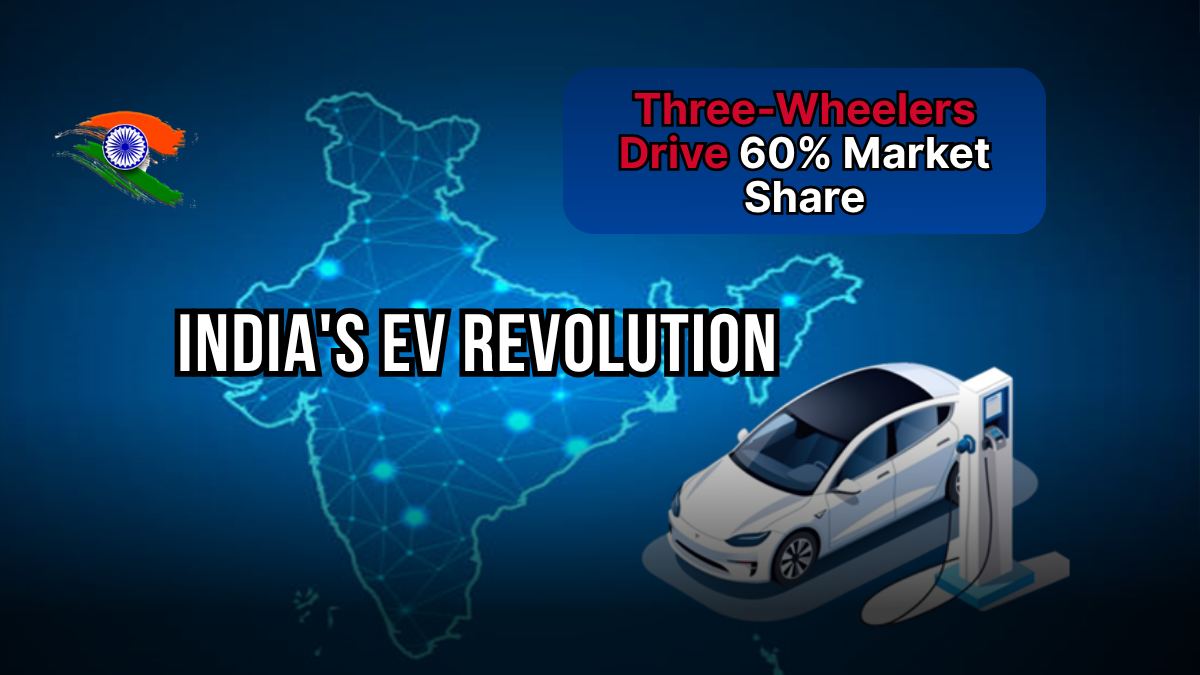
India’s EV Revolution: Three-Wheelers Drive 60% EV Market Share India is moving fast towards electric vehicles (EVs). With rising fuel prices, pollution, and government support, more people are choosing EVs for daily use. Among all electric vehicles, three-wheelers have become the biggest drivers of this revolution, capturing nearly 60% of the EV market share. This shows how important they are in India’s journey to clean mobility.
Why Three-Wheelers Are Leading the EV Market
Three-wheelers, also known as auto-rickshaws or e-rickshaws, are very popular in India. They are used for short-distance travel, passenger transport, and goods delivery. Switching them to electric makes sense because:
- Lower running cost – An electric three-wheeler costs only a fraction to run compared to petrol or diesel autos.
- Daily usage – They are used all day, so drivers save more money on fuel.
- Easy charging – Many e-rickshaws can be charged with simple sockets, and new battery swapping stations make them even more convenient.
- Affordable prices – Compared to electric cars, three-wheelers are cheaper and easier for drivers to buy.
Because of these reasons, thousands of drivers are shifting to electric three-wheelers.
The Growing Numbers
In the last few years, the number of electric three-wheelers sold has grown rapidly. Reports show that in 2024–25, almost 6 out of every 10 EVs sold in India were three-wheelers. This means that three-wheelers are not just popular, but they are also the foundation of India’s EV growth.
For example, in cities like Delhi, Lucknow, Patna, and Kolkata, you will find e-rickshaws everywhere. They have become a lifeline for middle-class passengers and small businesses.
Government Support
The Indian government is giving strong support to EVs. Schemes like FAME-II (Faster Adoption and Manufacturing of Hybrid and Electric Vehicles) and state subsidies make EVs cheaper. Drivers can also get loans with low interest to buy e-rickshaws.
Some state governments even provide special permits for electric autos. Charging stations are being built across highways and cities to make EV use smoother.
Benefits of Electric Three-Wheelers
The success of three-wheelers in the EV market is not just about sales—it also brings many benefits:
- Less pollution – They reduce harmful smoke, making city air cleaner.
- Lower noise – E-rickshaws are quieter, reducing noise pollution.
- Better income for drivers – With lower costs, drivers take home more profit every day.
- Job opportunities – As demand for e-rickshaws grows, more jobs are created in manufacturing, battery swapping, and charging infrastructure.
Challenges in the Path
Even though the growth is impressive, there are still challenges:
- Battery life – Many e-rickshaw drivers worry about battery replacement costs.
- Charging stations – While cities have some facilities, rural areas still lack proper charging infrastructure.
- Quality issues – Cheap, unbranded e-rickshaws sometimes enter the market and create problems for buyers.
- Awareness – Some drivers are still not fully aware of the long-term benefits of EVs.
If these issues are solved, the growth of three-wheeler EVs will become even faster.
The Role of Private Companies
Many companies are investing in electric three-wheelers. Brands like Mahindra Electric, Piaggio, Euler Motors, Atul Auto, and Kinetic Green are offering modern e-rickshaws and cargo three-wheelers. Startups are also working on battery swapping, fast charging, and financing options for drivers.
Delivery companies like Zomato, Swiggy, and Amazon are adding electric three-wheelers to their fleets to reduce costs and become eco-friendly.
Future Outlook
Looking ahead, India’s EV future looks bright. Experts believe that by 2030, most of the three-wheelers on Indian roads will be electric. This will help reduce oil imports, improve air quality, and make transportation cheaper for common people.
The success of electric three-wheelers also builds confidence for other EV segments like two-wheelers, buses, and cars. If India can lead in three-wheelers, it can set an example for the world.
Conclusion
India’s EV revolution is not just about shiny new cars—it is about the vehicles people use every day. Three-wheelers have taken the lead, making up 60% of the EV market share. With government support, private investment, and rising demand, these vehicles are shaping a cleaner, cheaper, and smarter transport future for India.